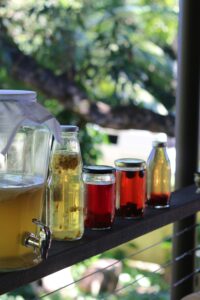
Brewing kombucha, once you’ve got the hang of it
This is for after you have gained some confidence, and just need a reminder of the basics.
There are SO many recipes out there. And here I wanted to share some of the flavours that I have discovered and love.
One of our jars of Kombucha makes just under 4 litres of plain kombucha. 10% of that you need to set aside for the next round. Leaving you with about 3.5 litres to bottle- 4 x 750ml of kombucha in a litre bottle, with space for flavour.
So with every brew, you have the opportunity to experiment with 4 separate flavour combos. I tend to do two bottles with a flavour I like, and the other two with something new.
My 3 tips are to:
Coffee
One of my yoga teachers told me this was so incredibly satisfying and far superior to a €7 iced coffee he’d just purchased, but a dear friend also told me it smelled like fish.. I believe she is wrong, but, the warning is there! I still believe it is a essential flavour to try if you love coffee. Use your favourite beans and cold brew if you can. A cold brew makes the final kombucha taste a little less acidic.
Tropical
This is my go to kombucha flavour. The passion fruit can overpower the mango a little, hence it is not 50:50. This one can also result in some big explosions, so be rigorous on bottle burping.
🫧 Extra fizzy – leave a bit more headspace
Berry
Strawberry kombucha is delicious, but I think adding a little basil gives a fresher taste. For your first try, blend the strawberries without the basil, so you have the opportunity to make a strawberry-only bottle to compare. Then blend the basil into the rest of the strawberries for another bottle. This way you can figure out your preference. I need to add a little kombucha to the blended strawberries to make it more pourable.
🫧 Extra fizzy – leave a bit more headspace
Fruity
Since Utrecht boasts the best cherry juice during the summer months, a cherry kombucha is a must. I just use the juice, but I am sure you could destone and use whole (or blended) cherries instead.
🫧 Extra fizzy – leave a bit more headspace
Classic
Another classic. This one makes me feel healthy. The turmeric addition does little to change the flavour, but it makes the colour beautiful and is good for your body. You can also add a pinch of black pepper – not really for flavour, but it helps the body absorb the turmeric’s curcumin.
Tropical
Mint and ginger are my favourite secondary pairings. Ginger’s warmth for the winter months, mint’s cool freshness for the summer.
🫧 Extra fizzy – leave a bit more headspace
Berry
As always, you can swap the mint for ginger if you want something warmer and less summery.
Berry
Make sure to blend the raspberries, so you get the most beautiful, deep red. Leave them whole and they can dim, looking a bit lifeless bobbing around in your booch – though it’s a purely aesthetic issue.
Floral
Possibly the most beautiful colour of the whole lot – but don’t be timid with the hibiscus tea. It needs to be really strong before you add it to the kombucha, otherwise it can disappear completely. The downside of making a very strong hibiscus tea is that it can become quite bitter, so if you find that happening, a little honey helps round it out.
Classic
A classic, and one of my favourite flavours for summer. With some resemblance of a mojito – zesty, minty and very refreshing. I find you don’t have the same level of bottle-opening drama as some of the fruitier options – which is another dimension of refreshing.
Classic
Appletiser was my favourite drink as a kid, so to me this is essentially the grown-up version. I prefer it just apple, but if you feel more fun, then there’s lots of space to experiment. Cinnamon is a particularly popular addition, and you could also try ginger, cloves or cardamom. You don’t actually need fresh apple at all if you want to keep things easy: good-quality 100% apple juice gives you a very convincing result without having to blend anything.
Floral
I shortcut and use elderflower cordial. I think if made your own, this would be even better. But I am lazy.
Floral
This one is a little more fiddly than most, and I haven’t quite cracked it yet. I find it surprisingly difficult to get enough rose flavour into the kombucha without the kombucha itself completely overpowering it. I haven’t been blending the rose buds so far, and I’m wondering whether that might actually be the answer. If you are struggling to find food-grade rose buds, I’ve found them in the spice section at Ekoplaza. This is definitely one for the experimental-bottle part of your brew rather than the one I’d make four bottles of before knowing what I think.
Tropical
I think this is the fizziest, most-explosive one that can ever exist. For example, when opening it at my front door, it managed to hit the pavement on the other side of the road. Nonetheless, it does taste great! You can also use canned pineapple.
🫧 Extra fizzy – leave a bit more headspace
Fruity
I’m not sure about this one, but I suspect that’s mostly my own preference talking – I’ve never really loved peach-flavoured drinks to begin with. My peaches also might not have been ripe enough, which wouldn’t have helped. If peach’s your thing, it’s worth trying with canned peaches or peach juice instead, rather than judging it on my batch alone.